
202.790.6192 (CALL)
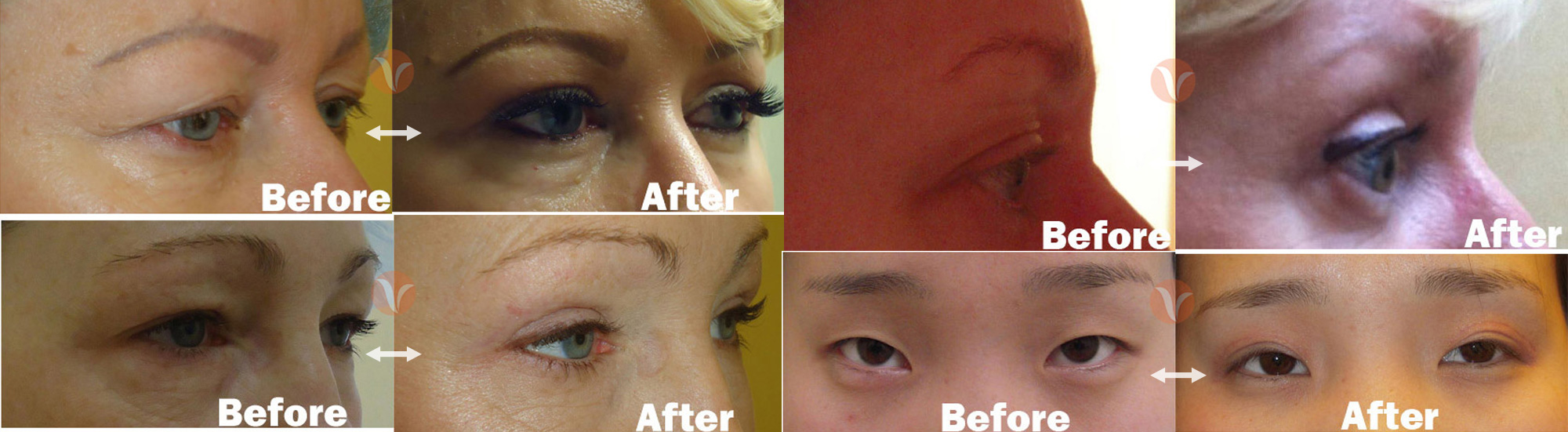

Lower Eyelid Bags
The lower eyelid may age in one of two ways. There may be premature eyelid aging, which is hereditary. People with this hereditary condition begin to demonstrate lower eyelid "bags" during the late twenties and early thirties. Most people, however, begin to show signs of eyelid aging in their early forties.
As the lower eyelid ages, the fat that surrounds the eye begins to accumulate under the eye and develop the "bags" that are visible. The skin also begins with age and develops wrinkles. The eyelid muscle can descend and give the eyelid a droopy look. As the malar fat (cheek fat) pad descends, a loss of volume can develop between the lower eyelid and the cheek. This creates a line that sharply demarcates the lower eyelid from the cheek.
Stages of Eye Bags
Stage A. Starting puffiness
Starting puffiness under the eyes can be largely eliminated or reduced by fillers. The skin under the eyes becomes smooth again thanks to fillers, which means you do not need to use as much concealer make up any more after your treatment. This treatment creates a subtle change in your appearance. Thus, people will be more likely to complement you on your fresh, young appearance, than to question you about cosmetic surgery.
Stage B. Deep eye bags
Deep bags under the eyes can be smoothened out using fillers. For the best result, it is sometimes necessary to supplement the volume directly under the eyes and on the cheekbone. With some luck, this will completely eliminate or reduce the deep puffiness. Due to its skin-enhancing and toning properties, you can also choose to do a TCA chemical peels to help with wrinkles around the eyes.
Stage C. Fluid retention
Fillers reduce fluid retention under the eyes, although these bags will never go away completely. Nevertheless, your look will be significantly improved after the treatment. If necessary, we may choose to further improve the puffiness with a tightening TCA chemical peel. Surgery is optional at this time.
Stage D. Deep fluid retention-large bags
With deep fluid retention, a treatment with only fillers is usually not sufficient – in this case, it is better to consider a lower eyelid bag removal, which removes fat deposits. An eyelid correction is performed under local anesthesia and its minimally invasive. With this surgery, it is common to make a small incision (cut) that allows for removal of the fat tissue and/or excess skin. This surgery takes approximately one and a half hours on average. We have over 15 years of experience in eye lid surgeries.
The lower eyelid surgery
The goal of the lower Blepharoplasty or eyelid surgery is to provide a smooth lower eyelid contour that blends with the cheek. This is done by removing the fat that protrudes underneath the eye, removing some of the excess skin, and then elevating and repositioning the eyelid muscle. This must be done in a manner that will maintain the patient's natural eyelid shape and avoid any malposition. Malposition is the name given to describe the change in the lower eyelid position that can occur from a poorly performed Blepharoplasty or eyelid surgery.
The lower eyelid Blepharoplasty or eyelid surgery can be performed via two different methods in our Washington dc surgical clinic. The skin muscle flap technique is performed through an incision just underneath the eyelashes. The skin and muscle are elevated to reach the fat pockets. The fat pockets are then removed. The amount removed must be just the right amount. If too much is removed, the eye may appear hollow after surgery. If too little is removed, then bulges will still be visible after surgery.
After the fat is removed, I tighten the eyelid muscle. This allows the contour of the eyelid to blend with the cheek. It also tightens the eyelid to prevent any eyelid malposition. The incision is then closed with tiny continuous stitch. This is my preferred technique for most patients that have lower eyelid aging. The technique allows me to remove the excess fat and tighten the eyelid muscle. The combination of these two rejuvenates the lower eyelid and cheek complex.
The second technique is the trans-conjunctival technique. I prefer to use this technique for young patients that need little to no skin removal or patients with very prominent eyes. The trans-conjunctival technique involves an incision inside the eye to access the fat. The fat is then removed and a small pinch of skin may be removed, if necessary, from underneath the eyelashes.


